The Sleep Schedule Protocol

Protocol #001
Most guys obsess over how many hours they sleep. The bigger lever is when.
Researchers put wrist sensors on about 61,00 adults, then followed them for about 6 years.
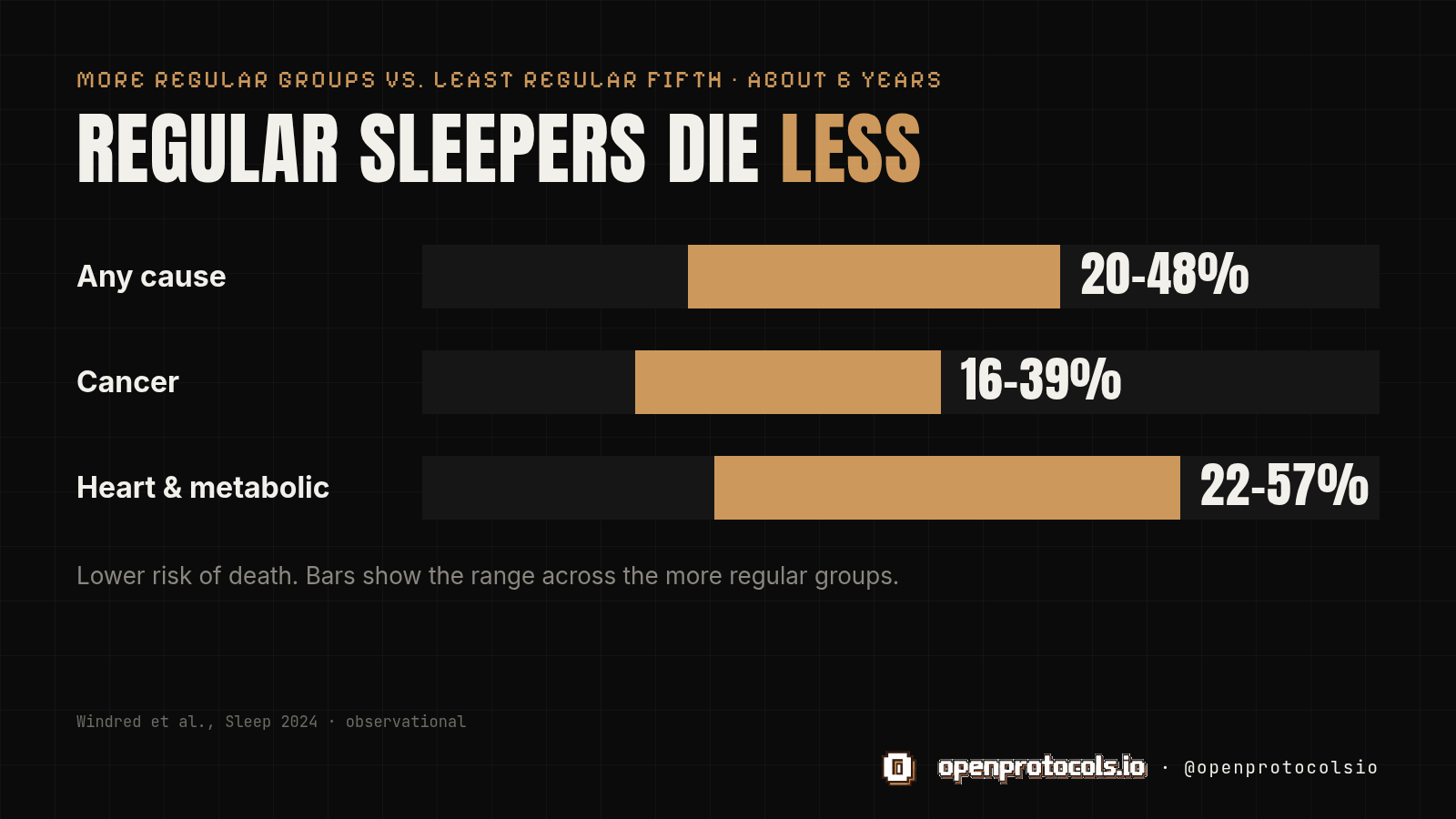
Compared with the least regular fifth, the more regular groups had a 20 to 48% lower risk of dying from any cause. Their risk of dying from cancer was 16 to 39% lower, and from heart and metabolic disease 22 to 57% lower.
Regularity predicted death better than sleep length did.
What a chaotic schedule does to guys our age
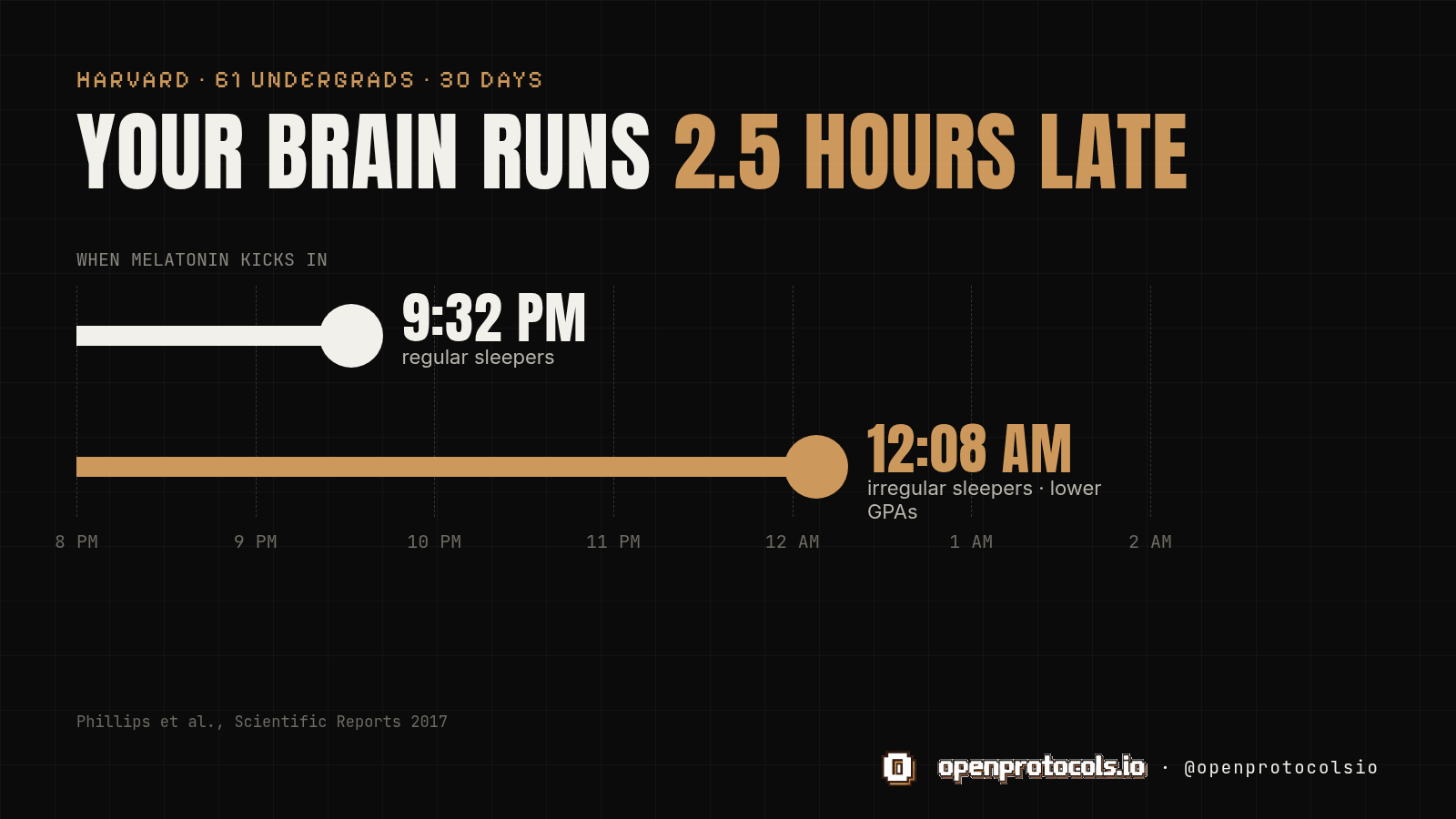
Harvard students with irregular sleep released melatonin at 12:08 a.m. The regular sleepers released it at 9:32 p.m. The irregular group also had lower GPAs.
Regular sleepers had 38% lower depression risk and 33% lower anxiety. Irregular sleepers had 48% higher depression risk, even when they got 7 to 9 hours.
Social jetlag means sleeping one schedule on weekdays and a later one on weekends. It's linked to higher BMI and more fast food.
After a week of 5-hour nights, testosterone drops 10 to 15%. At 6 hours or less, exercise performance drops 7.6%. When Stanford basketball players slept more, their shooting got about 9% better.
Disclaimer: most of this is observational. Regular sleepers might be healthier for other reasons too. The testosterone studies cut sleep short. None of them tested an irregular schedule. Still, every signal points the same way, and it costs nothing to run.
How to measure it
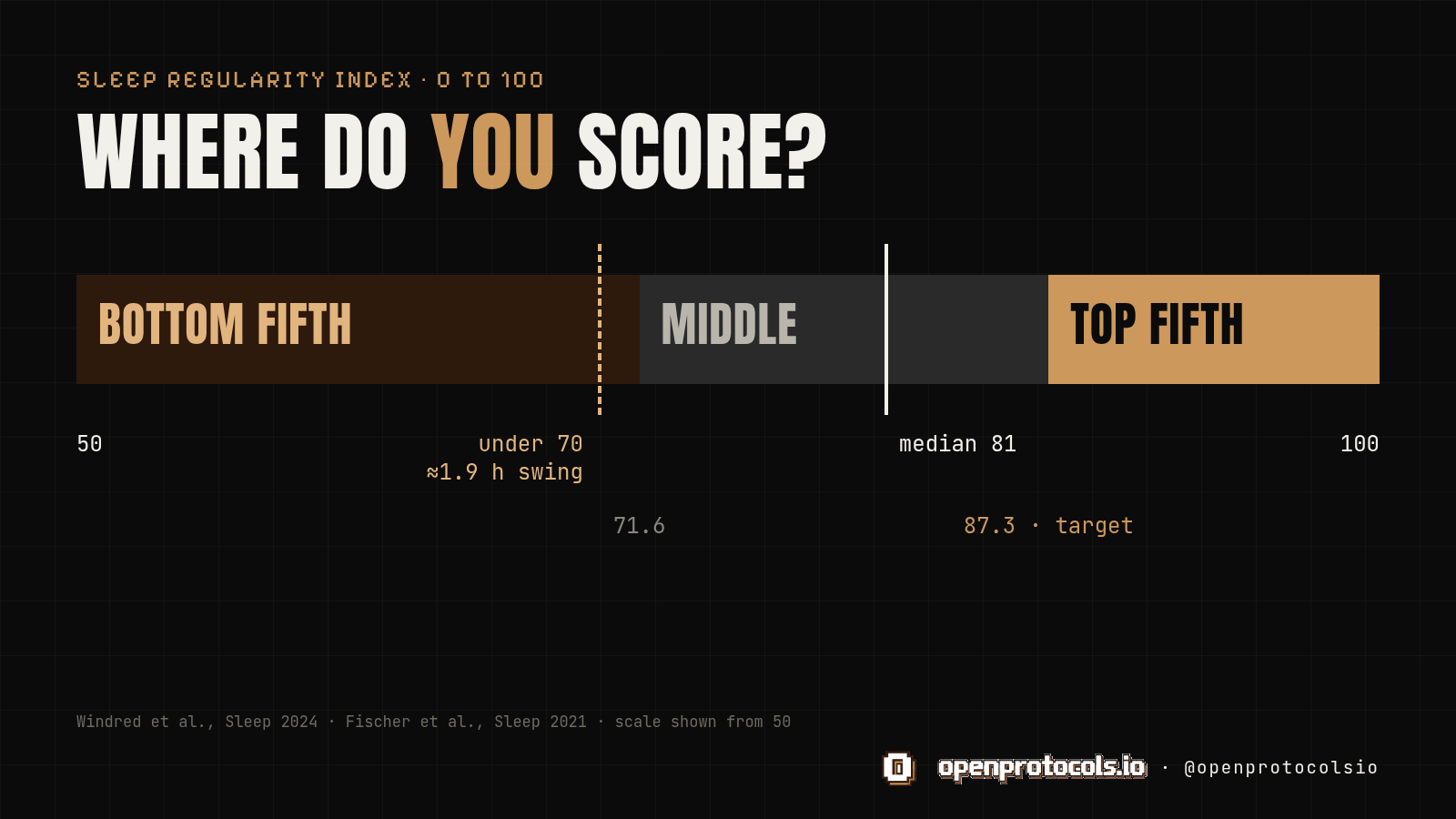
The Sleep Regularity Index (SRI) scores you from 0 to 100. It measures how likely you are to be in the same state, asleep or awake, at the same time on back-to-back days. The median is 81. The bottom fifth scores under 71.6 and the top fifth above 87.3.
An SRI under 70 works out to bed and wake times swinging by about 1.9 hours.
Wearable check
- Wear it every night for at least 2 weeks. SRI needs 5 days minimum. The spread of your bed and wake times needs more than a week to mean anything.
- Export your bedtimes and wake times.
- For each one, look at the gap between your earliest and latest night. Your target is under 1 hour on both.
- If you want the actual SRI, the free sleepreg package for R calculates it from your data.
Consumer wearables are a rough guide. They're decent on timing and sloppy on sleep stages. Use them for timing.
No wearable? Write your bedtime and wake time in a notebook the moment you get up. It works.
The protocol
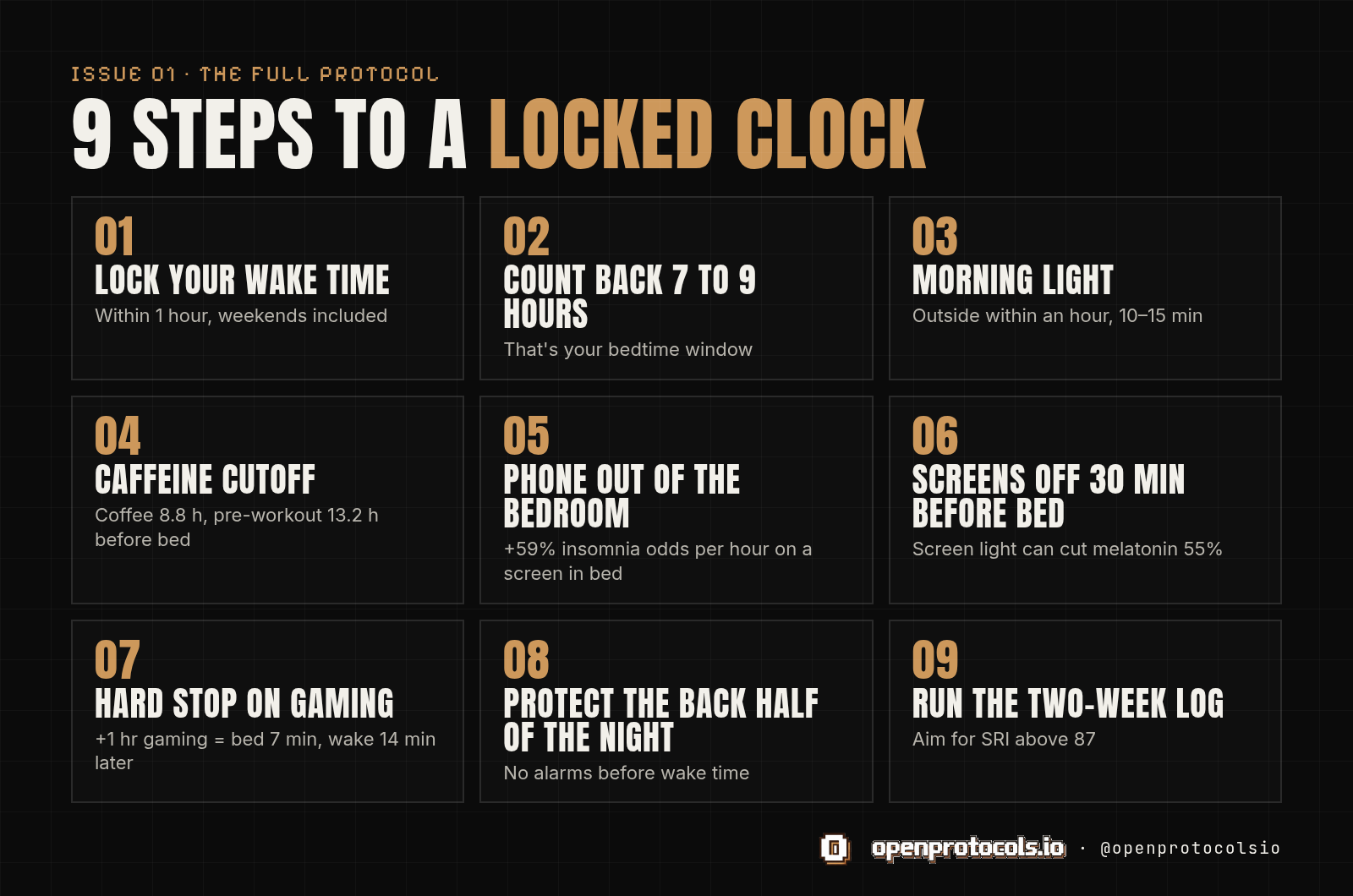
- Lock your wake time. Same time within 1 hour, weekends included. Everything else builds off this.
- Count back 7 to 9 hours. That's your bedtime window.
- Morning light. Get outside within an hour of waking. Start with 10 to 15 minutes, no sunglasses.
- Caffeine cutoff. Coffee 8.8 hours before bed, pre-workout 13.2 hours before bed.
- Phone out of the bedroom. Every hour on a screen in bed adds 59% to your odds of insomnia and costs about 24 minutes of sleep. Lying in bed more than an hour before you try to sleep makes poor sleep 9.3 times as likely.
- Screens off 30 minutes before bed. Screen light can cut melatonin by 55%.
- Hard stop on gaming. Every extra hour pushes bedtime about 7 minutes later and wake time about 14 minutes later. That's how a weeknight turns into a wrecked Saturday.
- Protect the back half of the night. No alarms before your wake time, no 4 a.m. phone check.
- Run the two-week log. Aim for an SRI above 87, which puts you in the top fifth.
Wind-down timeline
Built for an 11 p.m. bedtime and a 7 a.m. wake time.
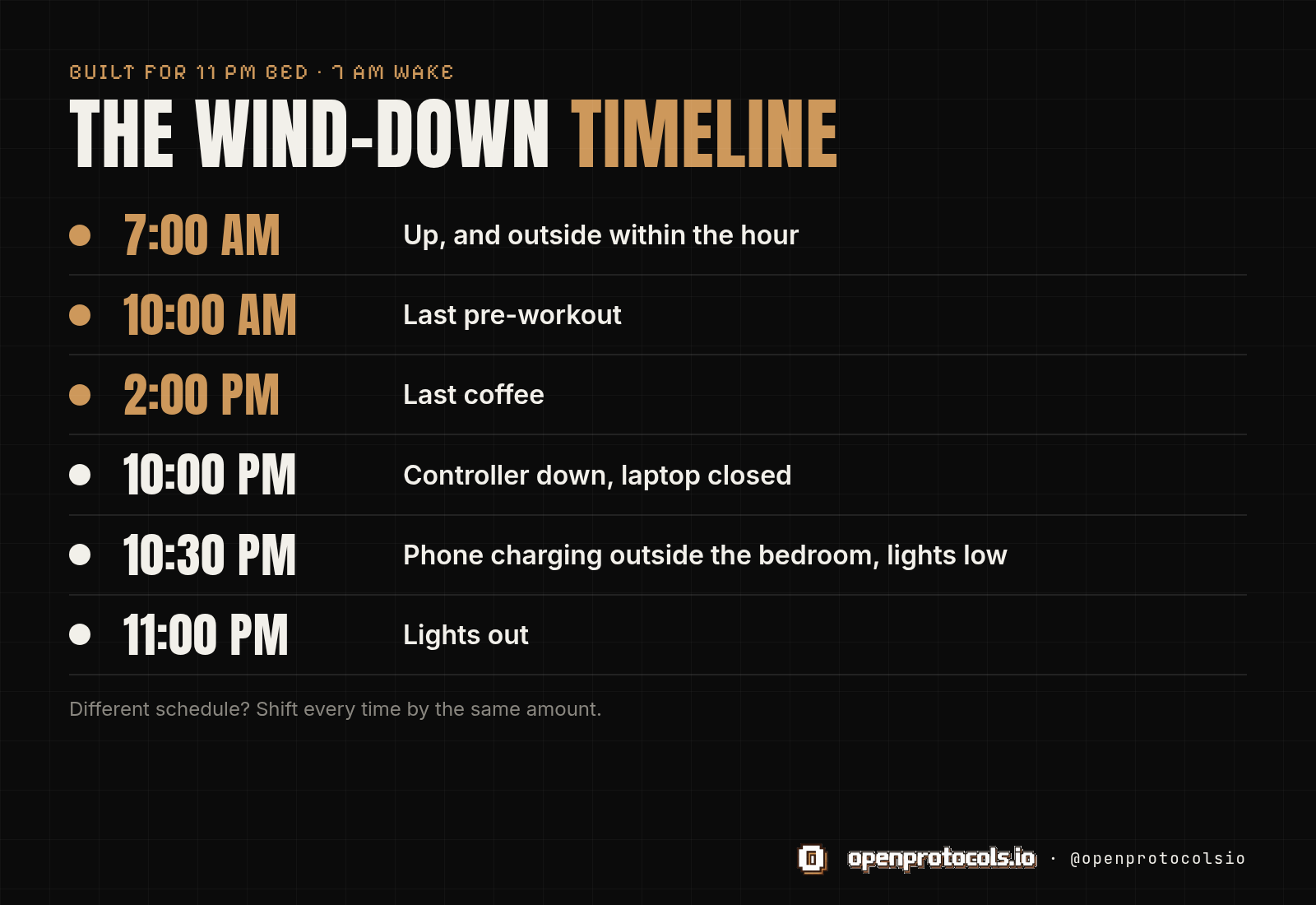
- 7:00 a.m. Up, and outside within the hour.
- 10:00 a.m. Last pre-workout.
- 2:00 p.m. Last coffee.
- 10:00 p.m. Controller down, laptop closed.
- 10:30 p.m. Phone charging outside the bedroom, lights low.
- 11:00 p.m. Lights out.
Shift every time by the same amount if your schedule is different.
Recovering from a late night
You'll blow it eventually. A wedding, a flight, a long night. Here's how to stop one night from wrecking the week.
- Get up at your normal wake time anyway, or within 1 hour of it. Sleeping until noon is exactly the swing that tanks your score.
- Get outside for morning light right away. It re-anchors your clock.
- Hold the caffeine cutoff. Chasing the tired with a 5 p.m. coffee breaks a second night.
- Go to bed up to 1 hour early the next night. Pay the sleep back at the front of the night and keep the wake time.
- Back on the normal schedule by night three.
What we don't know yet
Most of the big findings are observational. Several of the mechanism studies are small. Fitbit-based results are mixed. If you're still wrecked after a month of a locked schedule, see a doctor.
Sleep apnea and other problems won't fix themselves with discipline (for now). Big studies coming out showing Retatrutide might be curing sleep apnea, that's for a later date.
Set your wake time tonight. Hit it Saturday too.
Sources
- Windred et al., Sleep 2024. Sleep regularity and mortality, UK Biobank. pubmed.ncbi.nlm.nih.gov/37738616
- Windred et al., Sleep 2021. SRI method and the sleepreg package. academic.oup.com/sleep/article/44/12/zsab254
- Fischer et al., Sleep 2021. SRI cutoffs and timing variability. pmc.ncbi.nlm.nih.gov/articles/PMC8503839
- Phillips et al., Scientific Reports 2017. Irregular sleep, circadian timing and grades. pubmed.ncbi.nlm.nih.gov/28607474
- Psychological Medicine 2025. Sleep regularity and incident depression and anxiety. cambridge.org/core/journals/psychological-medicine
- Roenneberg et al., Current Biology 2012. Social jetlag and obesity. pubmed.ncbi.nlm.nih.gov/22578422
- High-school social jetlag study. pubmed.ncbi.nlm.nih.gov/27715325
- US teens social jetlag and diet study. pmc.ncbi.nlm.nih.gov/articles/PMC7554217
- Leproult & Van Cauter, JAMA 2011. One week of sleep restriction and testosterone in young men. pubmed.ncbi.nlm.nih.gov/21632481
- Sports Medicine 2022. Sleep loss and exercise performance meta-analysis. pmc.ncbi.nlm.nih.gov/articles/PMC9584849
- Mah et al., Sleep 2011. Sleep extension in Stanford basketball players. pmc.ncbi.nlm.nih.gov/articles/PMC3119836
- Gardiner et al., Sleep Medicine Reviews 2023. Caffeine and subsequent sleep. pubmed.ncbi.nlm.nih.gov/36870101
- Frontiers in Psychiatry 2025. Bedtime screen use in 45,202 students. pmc.ncbi.nlm.nih.gov/articles/PMC12015757
- Exelmans & Van den Bulck, Sleep Medicine 2017. Bedtime procrastination and poor sleep. pubmed.ncbi.nlm.nih.gov/28271575
- Phone-free before bed pilot trial. pmc.ncbi.nlm.nih.gov/articles/PMC7010281
- Chang et al., PNAS 2015. Evening e-reader use and melatonin. pmc.ncbi.nlm.nih.gov/articles/PMC4313820
- Exelmans & Van den Bulck, Journal of Sleep Research 2015. Gaming and sleep timing.pubmed.ncbi.nlm.nih.gov/25358428
- Schmid et al., Clinical Endocrinology 2012. Late-night sleep loss and hormones. doi.org/10.1111/j.1365-2265.2012.04419.x
- Dijk et al., 1989. Light and circadian timing. doi.org/10.1152/ajpregu.1989.256.1.r106