

The Plastic Free Protocol
Protocol #002
How plastic gets into your body, what the research links it to, and a cheap, simple protocol to cut your exposure starting today.
It's 7:00 a.m.
Your alarm goes off. You grab the plastic water bottle on the nightstand. It sat in a hot car yesterday afternoon. You drink half of it anyway.
You make tea. The bag is one of those silky pyramid ones. It looks premium. You pour boiling water straight over it.
Breakfast is last night's leftovers. You put the plastic container in the microwave. Three minutes. The lid is warped a little at the corner. It always has been.
On the way to work you stop for coffee. Hot coffee, plastic lid. You use the hand sanitizer by the register. The cashier hands you a receipt. You fold it into your pocket with your damp hands. Then you eat a breakfast bar out of its wrapper.
Lunch comes in a plastic clamshell. Dinner comes out of a can.
Nothing about this day is strange. It's what a normal day looks like for most guys. That's exactly the point.
By the time you go to bed, you've had a dozen small contacts with plastic and the chemicals that ride along with it. Each one is tiny. Each one is legal. Each one is "within limits."
Then researchers start cutting open human tissue. And they find plastic everywhere they look. In the testes. In semen. In artery plaque. In the brain.
This issue is about what that plastic is, how it gets into you, what the research links it to, and what you can do about it.
You can't live in a bubble. You don't need to. Most of your exposure comes from a handful of habits. Change those habits and you cut a big share of what goes in.
Let's start with the basics.
What You're Actually Dealing With
Three things get lumped together under "plastic." They act differently. It helps to keep them separate.
Microplastics
Microplastics are pieces of plastic smaller than 5 millimeters. Some are visible. Most are not. Below 1 micrometer they're called nanoplastics. That's small enough to slip into places bigger particles can't reach.
They come from everything plastic slowly falling apart. Bottles. Containers. Tea bags. Cutting boards. Packaging. Fibers. Heat, friction and age speed that up.
The common types have names you'll see on labels and in studies:
- Polyethylene (PE) The most common plastic on earth. Bags, films, bottle caps, cutting boards.
- Polypropylene (PP) Food containers, many microwave tubs, cutting boards.
- Polystyrene (PS) Foam cups, takeout boxes, disposable cutlery.
- PVC Pipes, cling films, some flooring, some tubing.
- PET Most water and soda bottles.
- Nylon (also called polyamide) Fabrics, filters, some tea bags.
BPA
BPA stands for bisphenol A. It's a building block of hard, clear polycarbonate plastic. It's also used in the lining of many food and drink cans. And it has long been used as the developer on thermal receipt paper, the shiny kind that prints without ink.
BPA's problem is its shape. It looks enough like estrogen to bind estrogen receptors. That means it can nudge hormone signaling in your body at very low doses. Your body clears it fairly fast, in hours. But you keep taking it in, so levels stay topped up.
When BPA got bad press, many companies switched to BPS or BPF. Those are also bisphenols. "BPA-free" doesn't mean bisphenol-free.
Phthalates
Phthalates (say "THAL-ates") are chemicals added to plastic to make it soft and flexible. Think soft PVC: tubing, cling films, gaskets in jar lids, vinyl. They're also used in fragrances, lotions and other personal-care products to help scents last.
The most studied one is DEHP. Phthalates don't bond tightly to the plastic. So they leak out, especially into fatty food and especially with heat.
The key fact about phthalates: several of them act as anti-androgens. Androgens are male hormones, with testosterone at the top. An anti-androgen works against that signal. That's why phthalates show up again and again in research on male development, sperm and testosterone.
So here's your cast:
Microplastics ➔ physical particles that build up in tissue.
BPA ➔ an estrogen mimic.
Phthalates ➔ anti-androgens that leak out of soft plastic and scented products.
Same source. Three different ways to mess with you.
Where it Enters Your Day
Let's go back to that morning we were talking about during the beginning of the newsletter...
The Water Bottle
In 2024, a team at Columbia used a new laser imaging method to count particles in bottled water. They tested 3 brands. They found about 240k particles per liter. About 90% of them were nanoplastics.
The most common type was nylon, likely from the filters used to purify the water. Next was PET, the plastic of the bottle itself.
Be skeptical here. A published letter in the same journal argued the blank controls were weak. The team's own lab-water blank showed similar contamination. So the exact number is loose.
The direction still matters. Water sold as "pure" comes packaged in plastic, passed through plastic filters, and often sits in heat on trucks and in cars. You can skip all of that for almost nothing.
The Tea Bag
In 2019, researchers in Canada steeped "silky" plastic tea bags at 95°C, roughly what you get from a kettle. One single bag released about 11.6 billion microplastics and 3.1 billion nanoplastics into the cup.
The caveat: this was nylon and PET pyramid bags. Paper bags were not the subject. Loose-leaf tea skips the question entirely.
The Microwaved Container
In 2023, a team at the University of Nebraska microwaved plastic baby-food containers for 3 minutes. The release reached about 4.2 million microplastics and 2.1 billion nanoplastics per square centimeter of container.
Per square centimeter. A normal tub has hundreds of them.
They used water and a mild acid in place of real food. They didn't measure what ended up in anyone's body. But the mechanism is simple. Heat breaks plastic down faster. Microwaving puts heat right into the food touching the plastic.
That warped lid you've ignored for months? That's plastic that's been cooking.
The Cutting Board
You chop food on a plastic board. Every cut leaves grooves. Every groove sheds bits of plastic into your food.
A 2023 study estimated you could take in about 15 to 72 million polyethylene particles a year from a PE board. For polypropylene boards, about 79 million a year.
That's a model estimate, with no measurement in people. And a cell test in the same study found no toxicity. Still, it's one of the easiest swaps on this list.
The Receipt & Hand Sanitizer
Thermal receipts carry bisphenols on their surface. They rub off on your fingers.
In a 2014 study, people used hand sanitizer, then held thermal receipt paper, then ate food with their hands. BPA in their blood and urine went up.
Here's the mechanism. Sanitizers contain ingredients that help chemicals cross skin. Your hands go from dry paper-touchers to a sponge. Then you pick up food and move it straight to your mouth.
The groups were very small and the test paper was high in BPA. But the pattern is so easy to avoid that it's worth knowing.
Cans & Packaged Food
Many cans are lined with coatings that have used BPA. Packaged food runs through plastic tubing, plastic conveyors, plastic films and plastic tubs before it reaches you. Phthalates love fat. So fatty, processed, packaged food tends to carry more of them.
You'll see in Part 3 how big this source is. When people stopped eating packaged food for just 3 days, their BPA and phthalate markers dropped hard. That one study tells you where the bulk of your exposure lives. It lives on your plate.
Heat in General
If you remember one rule from this section, remember this one:
Heat + plastic + food = the worst combination.
Cookware
Old, scratched nonstick pans and plastic spatulas take a beating at high heat. Plastic utensils that melt a little at the edges are shedding. No study in our pack puts a number on human intake from cookware. So we won't give you one.
The logic is the same as the cutting board: friction plus heat sheds material. Cast iron, stainless steel, wood and silicone-free metal utensils sidestep it.
Clothes
Polyester, nylon and acrylic fabrics shed fibers. That's well documented in laundry studies. What's not documented is how much of that ends up inside you. There's no verified number on human uptake from clothing. So this one sits low on the list.
If you're replacing basics anyway, cotton, wool and linen are easy picks. Don't throw out your gym clothes over it.
Cosmetics & Fragrance
Phthalates are used to make scents last longer. On a label, they often hide behind one word: "fragrance." Body spray, cologne, scented deodorant, scented lotion, scented laundry products. You put these on your skin every day, sometimes several times.
We don't have a clean number for how much each one adds.
But you don't need one to make an easy move:
- Fewer scented products.
- Fragrance-free versions of the ones you keep.
What The Research Links It To
Now the hard part. What does all this plastic actually do?
A quick rule before we go in. Most of what follows is observational. Researchers measured plastic, measured an outcome, and found they move together. That's a link. It isn't proof of cause. So you'll see "linked to" a lot. That's the honest phrasing.
Where the evidence is animal-only, we'll say so. Where it's a real human trial, we'll say that too.
Plastic in the Testes
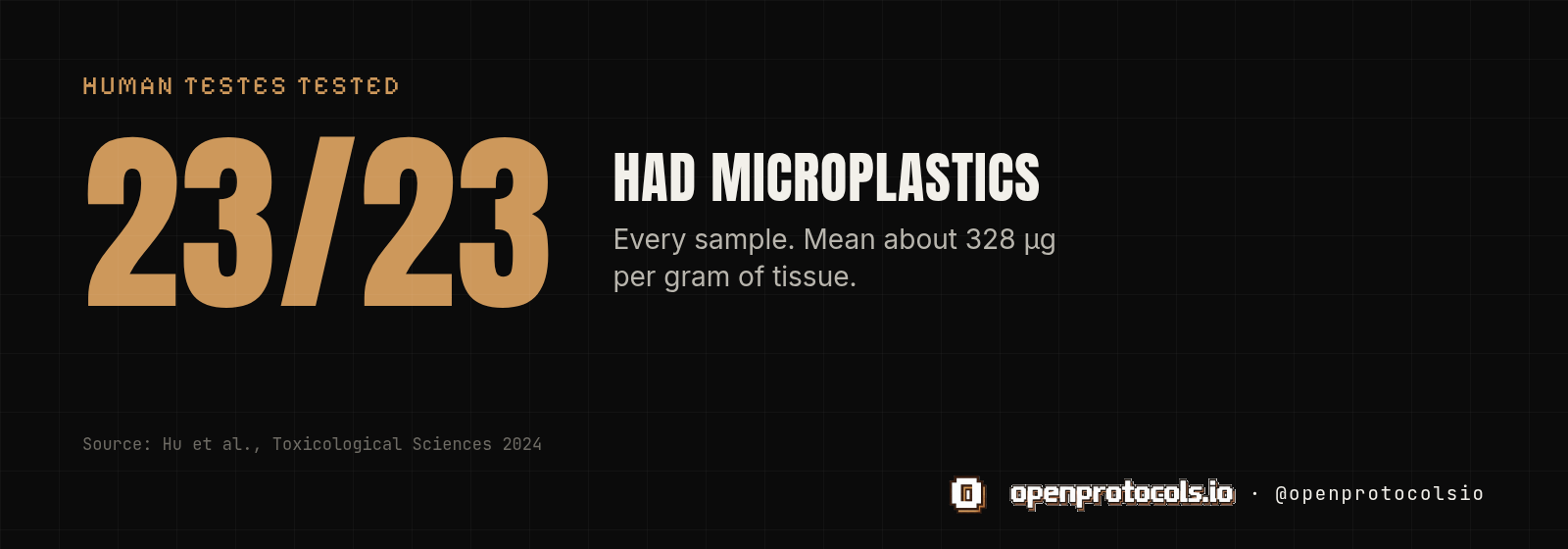
In 2024, a team at the University of New Mexico tested testes from 23 men at autopsy and 47 dogs. Every single sample had microplastics. 23 of 23 men. 47 of 47 dogs.
The average in humans was about 330 micrograms of plastic per gram of tissue. In dogs it was about 120. So human testes held roughly 3x more plastic than dog testes.
Polyethylene was the main type.
Here's the part that matters most for you. In the dogs, the team could also count sperm. Dogs with more PVC in their testes had lower sperm counts. PVC and PET were also linked to lower testis weight.
In the men, they couldn't count sperm. The tissue was preserved, so that data didn't exist. And in dogs, it's a correlation.
So read it like this:
Plastic reaches the organ that makes your testosterone and your sperm.
In the one species where they could check, one type of plastic tracked with fewer sperm.
Plastic in Semen
It reaches semen too.
In Italy, 6 of 10 semen samples from healthy young men had microplastics. 16 fragments, 8 different plastic types. That was a small sample from a heavily polluted region.
In China, all 40 semen samples tested had microplastics. About 2 particles per sample on average. Polystyrene was the most common. Semen with PVC had lower sperm motility than semen with polystyrene: about 19% vs 44% of sperm moving properly.
Then a bigger study. In 2024, researchers sampled 113 men across 3 regions of China. Microplastics showed up in every semen sample and every urine sample.
They counted how many different plastic types each man carried. Each extra plastic type was linked to:
- About 15 million fewer total sperm.
- About 7 million fewer sperm per milliliter.
About 8 points lower progressive motility, the share of sperm that swim forward.
The comparison is simple. Picture two men. One carries 2 plastic types. The other carries 3. On average, the second man has about 15 million fewer sperm.
The study tracked only whether each type was present. It didn't measure hormones. It's still observational. But it's the clearest human link between microplastics and sperm so far.
How could plastic hurt sperm?
Animal work points to a few routes. Particles trigger oxidative stress, a flood of reactive molecules that damage cell membranes and DNA. Sperm are especially exposed to this. They're packed with fragile fats and have almost no repair kit. Particles also seem to stress the blood-testis barrier, the wall that protects developing sperm.
Testosterone (Animal Evidence)
No human study has yet linked the amount of microplastic in your body to your testosterone level.
So we'll be precise.
In mice, 6 weeks of polystyrene microplastics lowered sperm count, lowered motility, raised the number of deformed sperm and lowered testosterone. The route was oxidative stress. An antioxidant partly reversed the damage.
In a 2024 mouse study, polystyrene particles lowered testosterone and pushed Leydig cells, the cells in your testes that make T, toward self-destruction.
In rats, even low doses lowered testosterone and sperm count in a dose-dependent way over 45 days. More plastic, lower T.
Meanwhile the brain's signal hormones, LH and FSH, went up. That's the body shouting louder at testes that answer more quietly. Those groups were tiny: 5 rats each.
Animal doses are often far higher than what you get.
Mice aren't men. But the mechanism is consistent across labs:
Plastic gets to the testes ➔ oxidative stress ➔ Leydig cells struggle ➔ less testosterone, worse sperm.
Testosterone (Phthalates in Humans)
Here the human data is stronger.
A national US sample of about 2,200 people, from the NHANES survey, measured phthalate breakdown products in urine and testosterone in blood.
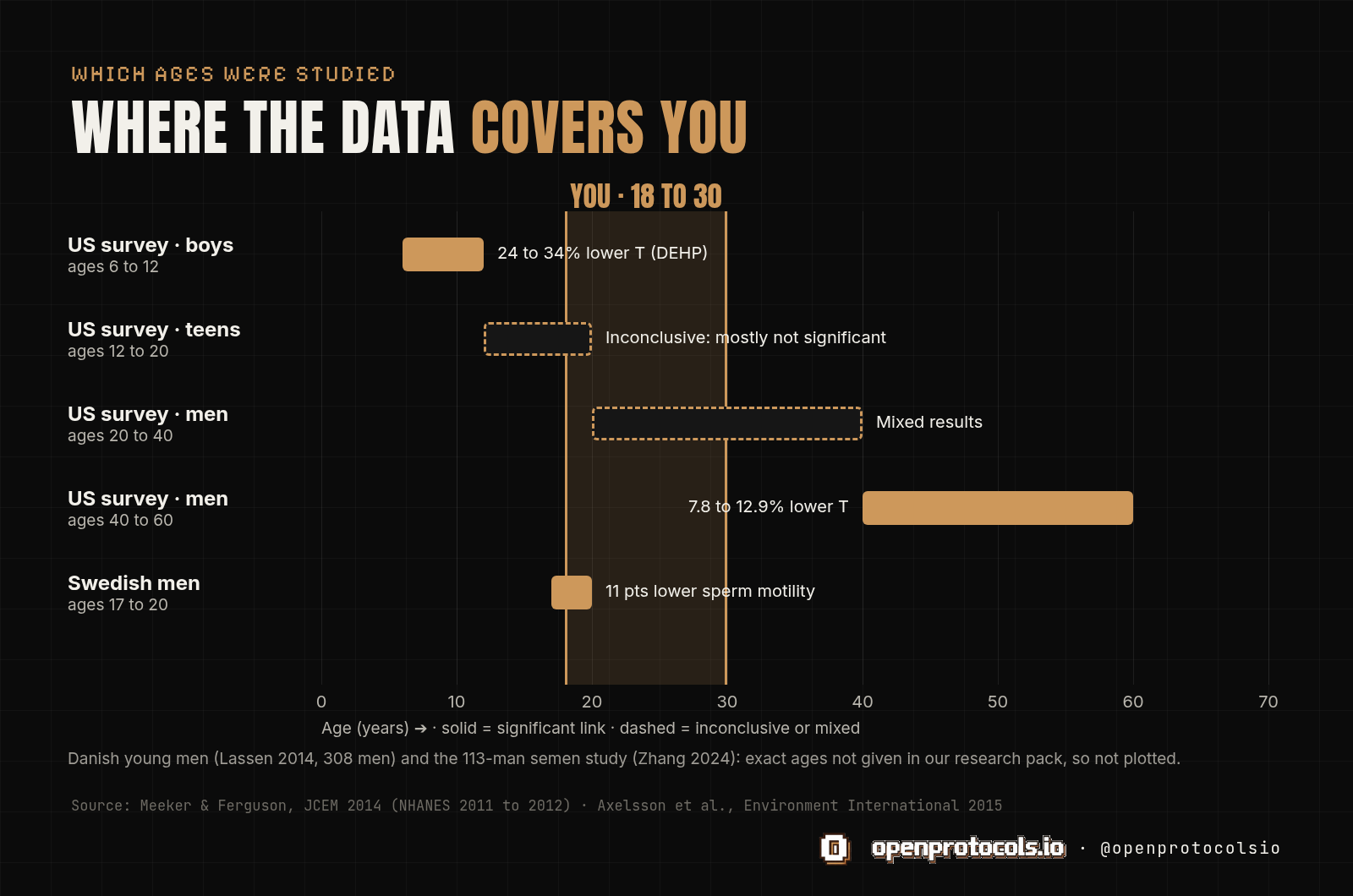
Compare a man with lower DEHP exposure to a man with higher exposure, roughly the middle band of the population. In men aged 40 to 60, the higher-exposure man had about 8% lower testosterone. For another phthalate, MBP, about 13% lower. In boys aged 6 to 12, the gap was 24 to 34%.
In ages 12 to 20, the results were mostly not significant. So the clearest hits showed up in kids and men over 40. In guys in their teens and 20s, the picture is mixed.
Mixed isn't a pass. The men aged 40 to 60 in that study were in their 20s once. And they've been exposed every year since.
A 2024 analysis pooled 37 studies and about 29,000 people. Higher DEHP was linked to lower total testosterone and a lower free androgen index, a measure of how much T is available to work. The effect per unit of exposure was small. It was stronger in infertile men. You're exposed every day, though. Small effects stack.
How do phthalates do it?
- They act on Leydig cells.
- They turn down the genes that build testosterone from cholesterol.
- Less raw production ➔ less T.
Sperm in Young Men
One study did look right at your age group.
In Sweden, researchers tested 314 young men aged 17 to 20 from the general population. Compare the top quarter of DEHP exposure to the bottom quarter. In the top quarter, sperm motility was 11 points lower. No consistent hit to testosterone. Sperm took the hit.
BPA has a twist. In a study of 308 young Danish men, the top quarter of BPA exposure had about 18% higher testosterone than the bottom. The researchers think the body may be compensating, pushing harder against BPA's effects. LH, the brain's "make more T" signal, was 22% higher too. But sperm motility was worse: 56% vs 63%.
Higher T and worse sperm. Biology is messy. We'll update you when the data does.
And in 190 men at a fertility clinic, higher BPA was linked to lower sperm concentration, worse motility, worse shape and about 10% more sperm DNA damage. The authors called it suggestive. One urine test per man.
The Womb
Some of your exposure happened before you could do anything about it.
In 85 mother-son pairs, compare mothers in the top quarter of MBP exposure during pregnancy to the bottom quarter. Sons of the top-quarter mothers had about 10x the odds of a shorter anogenital distance. That's a physical marker of how much testosterone was acting on the baby in the womb. A shorter distance means less androgen action.
You can't change that now. But you can change what you pass on, if you ever plan to have kids.
Zoom out.
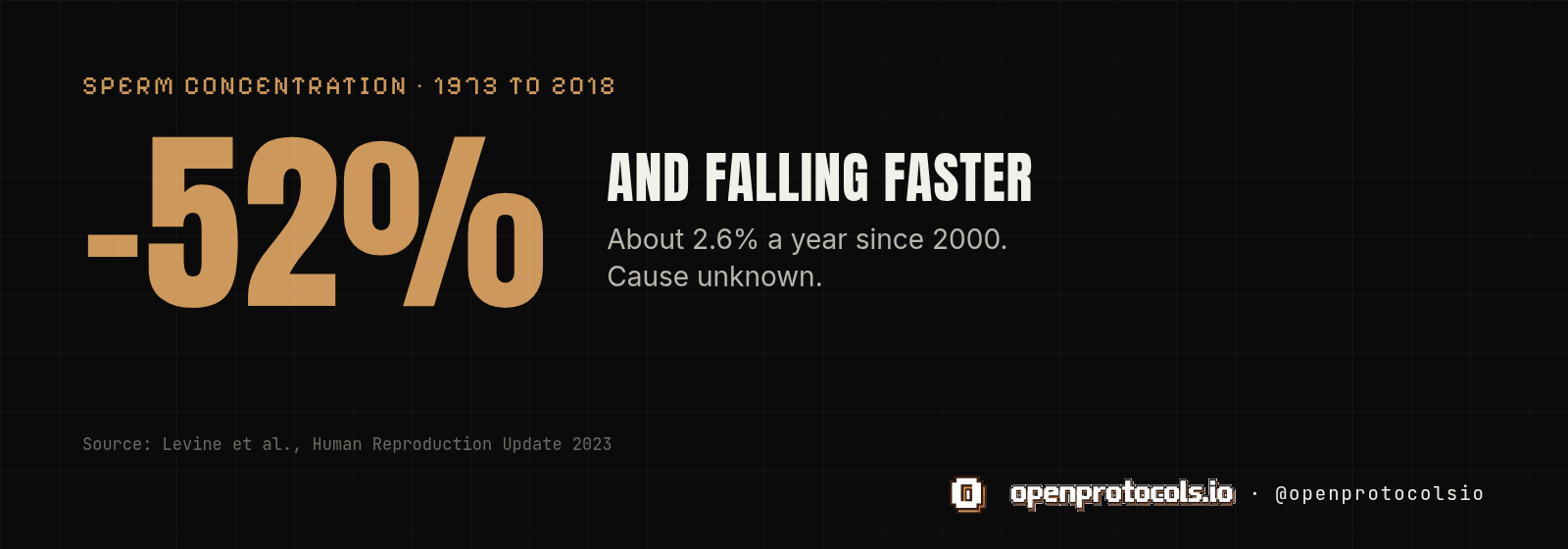
In 2022, a team pooled 223 studies from 53 countries covering 1973 to 2018. In men not selected for fertility problems, average sperm concentration fell from about 101 million per milliliter to 49 million. That's a drop of about 52%. Total sperm count fell about 62%.
And it's speeding up. After 1972, the decline was about 1.2% a year. After 2000, it was about 2.6% a year.
The paper does not blame plastic. Nobody knows the cause yet. Diet, weight, inactivity, smoking, heat and chemicals are all suspects.
Plastic is one suspect. It hasn't been convicted. But it shows up at the scene a lot.
Your Arteries
This one moved the field.
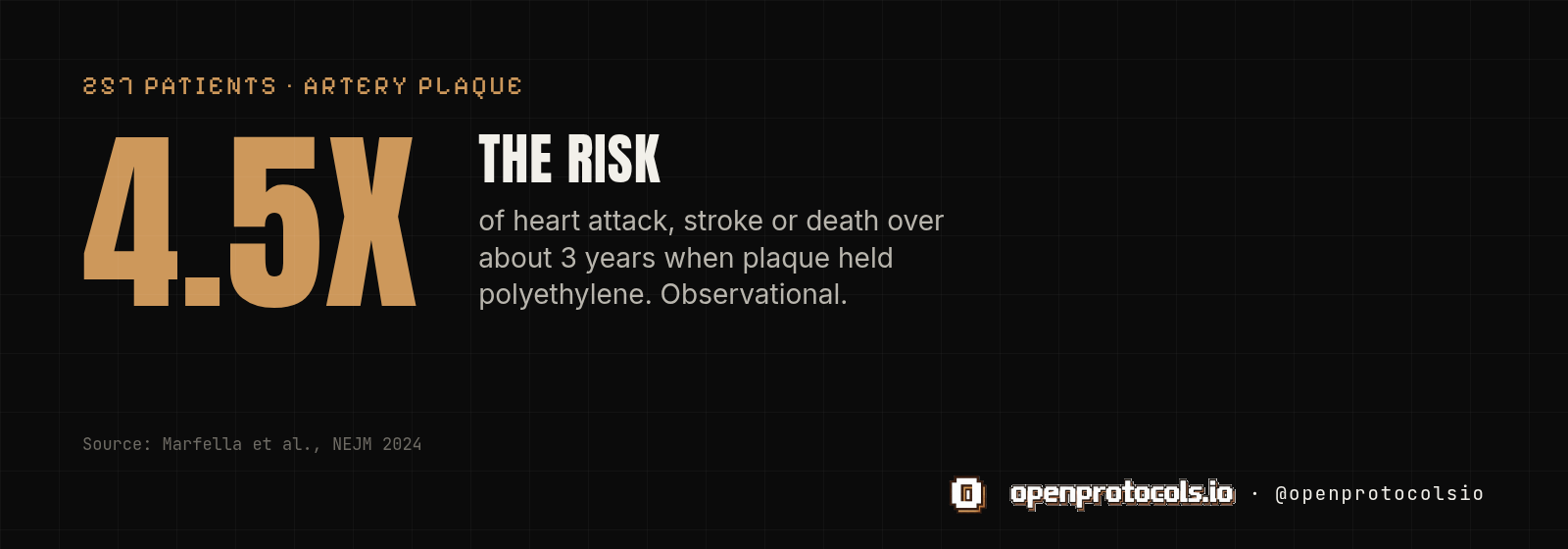
In 2024, a team in Italy studied 257 patients having surgery to clear fatty plaque from the carotid artery in their neck. They tested the plaque they removed for plastic. About 58% had polyethylene in it. About 12% had PVC.
Then they followed everyone for about 3 years.
The comparison:
- Patients with plastic in their plaque ➔ 20% had a heart attack, stroke or died.
- Patients without it ➔ 7.5%.
After adjusting for age, smoking, diabetes and other risks, the plastic group had about 4.5x the risk.
Under the microscope, particles sat inside immune cells in the plaque.
Those plaques showed more inflammation.
That's the proposed mechanism.
Plastic in the artery wall ➔ chronic inflammation ➔ unstable plaque ➔ higher odds it ruptures.
Now the skepticism. These were older patients who already had serious artery disease. It's observational. Critics noted there were no operating-room blanks to rule out contamination.
But it's the first time plastic in human tissue was tied to hard outcomes like heart attacks and death. Your heart and your erections run on the same blood vessels.
What's bad for one is rarely good for the other.
Your Brain
12 brains from people with dementia had much higher levels still.
Two caveats. First, the authors say no cause is assumed. Dementia could let more plastic in, instead of plastic causing dementia. Second, the method is disputed. A published critique and Germany's risk agency both flagged weak contamination controls and measurement issues that could overstate the numbers.
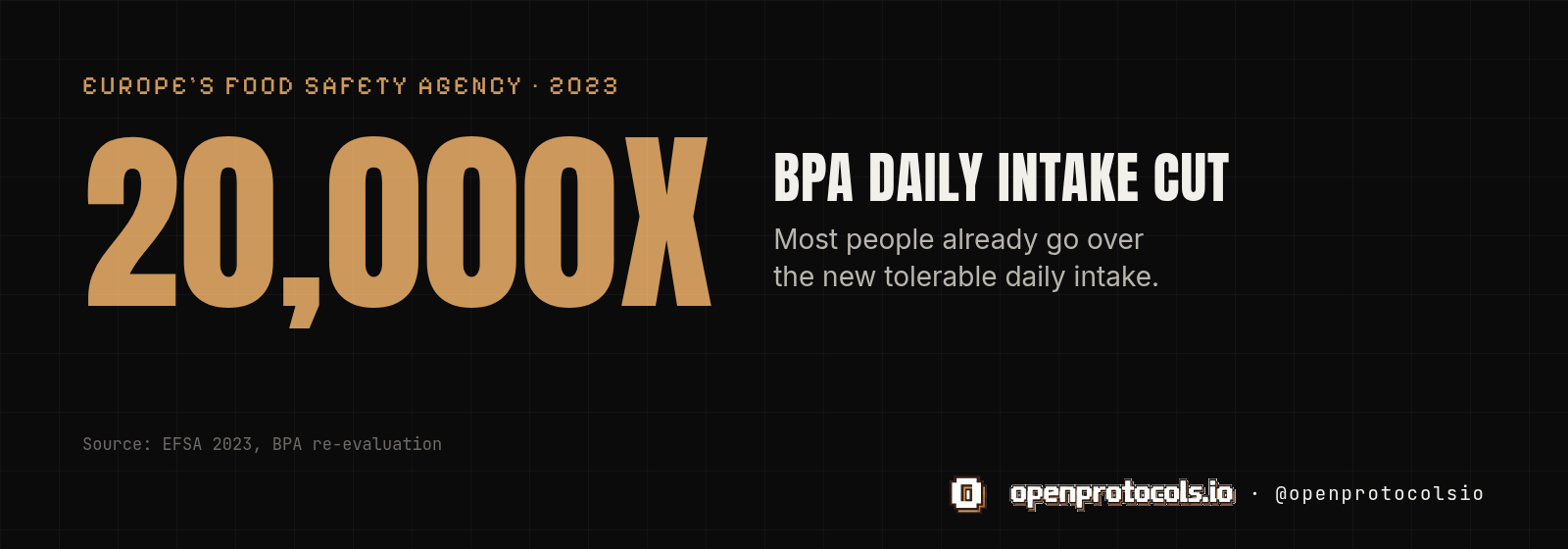
In 2023, Europe's food safety agency, EFSA, re-evaluated BPA. It cut the tolerable daily intake from 4 micrograms per kilogram of body weight to 0.2 nanograms. That's about 20,000x lower.
Then it compared that limit to what people actually take in from food. Average and high consumers in every age group were over the new limit by 100 to 1,000 times. EFSA called that a health concern.
The main effect behind the cut was on the immune system in mice. Sperm motility effects were noted at similar doses. Another EU agency published a different view. So the experts don't fully agree.
Still, think about what happened. For years, a chemical was "safe" at one level. Then the same agency decided safe was 20,000x lower. And most people were already over it.
"Within limits" means less than it sounds like.
Why it Matters for You
You're young. Your arteries are probably clean. Your T is probably fine. So why care?
Three reasons:
- It builds up. Brain samples from 2024 held more plastic than 2016 samples. Testes from younger men held plenty. You aren't starting at zero, and your daily habits decide which direction you go from here.
- Your exposure is a habit stack. Most of it comes from what you eat, what you drink and what you heat it in. Those are habits you set in your 20s and keep for decades. A 25-year-old who drinks from plastic bottles and microwaves in tubs will likely do it at 45. The men in that NHANES data with lower T were 40 to 60. You get to decide what your 40s look like now.
- The cost of acting is tiny. A glass container. A steel bottle. Loose tea. A wood board. Saying "no receipt." None of it is expensive. None of it takes much time.
Plastic chemicals block testosterone in animals. They're linked to lower T and worse sperm in people. Microplastics reach your testes, your semen and your arteries. And you take them in at almost every meal.
That's enough to act on. Especially when acting is this cheap.
And there's one more reason. The industry that makes these materials also funds plenty of the reassurance about them. "BPA-free" turned into BPS. "Safe" turned out to be 20,000x too high. You don't need to be paranoid. You just need to stop handing your health to the label.
The Protocol
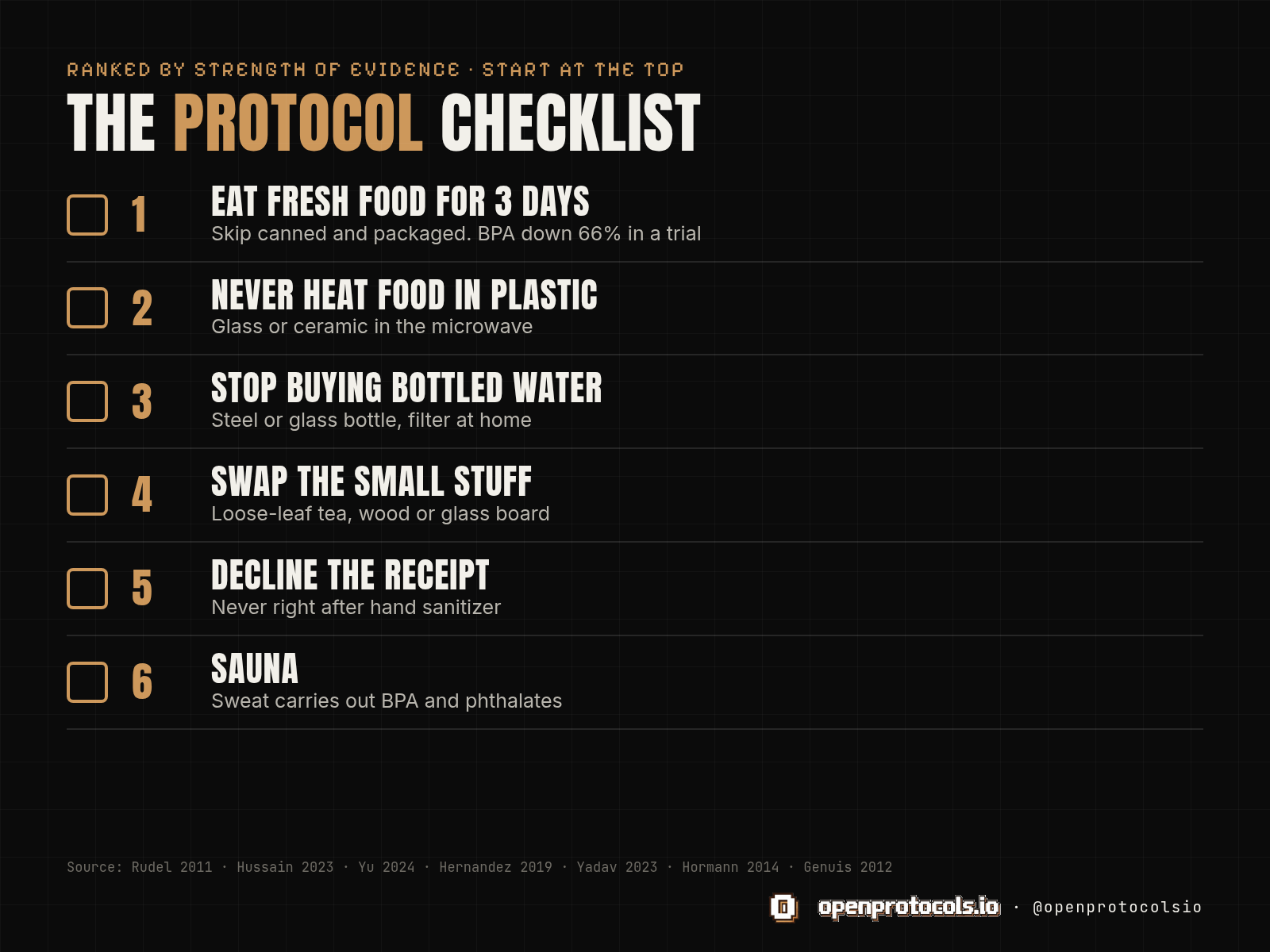
Ranked by how strong the evidence is.
Start at the top.
Each step cuts what goes in. None of them is proven to pull out plastic already in your tissue. That's fine. Stopping the inflow is the part you control.
Eat Fresh Food for 3 Days
This is the step with a real human trial behind it.
In 2011, researchers took 20 people from 5 families. For 3 days, they ate fresh food cooked at home, stored in glass and steel, with no canned food and no plastic packaging.
Compare their urine before and during the 3 days: BPA dropped by 66%.
DEHP breakdown products dropped by about 55%.
When they went back to their normal diet, levels came right back up.
It's a small study, and it measured exposure only. Still, in 3 days, about two-thirds of the BPA was gone. Then it returned the moment the old habits did.
That tells you two things. Most of your exposure comes from food packaging. And your body clears these chemicals fast once you stop feeding them in.
Run your own 3-day test this week. Fresh meat, fish and eggs from the counter, wrapped in paper if you can. Fresh or frozen vegetables, fruit, rice, oats, potatoes, beans cooked from dry. Cook it yourself. Store it in glass or steel.
Cheap Swaps
- Canned beans ➔ dry beans cooked in a big batch.
- Canned tomatoes ➔ tomatoes in glass jars, or fresh.
- Packaged snack bars ➔ fruit, nuts from bulk bins, eggs.
- Microwave meals ➔ a pot of rice and a tray of roasted meat and vegetables on Sunday.
- Cans of soup ➔ homemade soup, frozen in glass jars.
The Realistic Version
You won't eat perfectly. Aim for most of your meals to be fresh and home-cooked. When you do eat packaged food, pick the less processed option and get it out of the plastic before you heat it. 80% of your meals done right beats 100% of them done right for one week and then quitting.
Never Heat Food in Plastic
Heat drives plastic to shed particles and leak chemicals. 3 minutes in the microwave released millions of microplastics and billions of nanoplastics per square centimeter of container in lab tests. Phthalates move faster into hot, fatty food. Take away the heat and you take away the biggest accelerator.
Microwave only in glass or ceramic. Store leftovers in glass or steel. Let hot food cool before it touches plastic, if it has to touch plastic at all. Hot coffee or tea goes in a ceramic mug, a steel travel mug or a glass cup. Skip the plastic lid when you can.
Cheap Swaps
- Plastic tubs ➔ a set of glass containers with lids. Even the lid can stay off in the microwave. Put a plate on top.
- Old takeout containers you've been reusing ➔ recycle them.
- Plastic travel mug ➔ steel.
- Plastic spatula and spoons ➔ wood or steel.
- Scratched nonstick pan ➔ cast iron or stainless steel.
The Realistic Version
You get takeout. Fine. Move it to a plate before you reheat it. Throw out any plastic container that's warped, cloudy or scratched. That's plastic telling you it's breaking down.
Stop Buying Bottled Water
Bottled water was found to hold about 240k particles per liter, mostly nanoplastics. Even if the true number is lower, you're drinking out of plastic, filtered through plastic, often after it sat in heat.
Carry a steel or glass bottle. At home, filter your tap water. Reverse osmosis, or RO, filters push water through a membrane fine enough to physically block particles. No human trial has shown RO lowers the plastic in your body. But the physics are on your side.
If you can't install RO, boiling helps. A 2024 lab study boiled tap water and then poured it through a simple filter, like a coffee filter. In hard water, the minerals form crust as they boil, and the crust traps plastic. That removed 80 to 90% of nano and microplastics. In soft water, it was closer to 25%. White crust in your kettle means hard water.
Cheap Swaps
- Bottled water ➔ a steel bottle, filled at home.
- Plastic pitcher filter ➔ fine as a start, but avoid leaving it in sun or heat.
- No budget for RO ➔ boil, let it cool, pour through a coffee filter into a glass jug.
The Realistic Version
You'll still grab a bottle at the airport now and then. That's fine. The win is your daily default. If 9 of every 10 drinks come from your own bottle, you've already flipped it. And never drink from a plastic bottle that's been sitting in a hot car.
Swap the Small Stuff
These are the easy, one-time changes. A plastic tea bag released about 11.6 billion microplastics into a single cup. A plastic cutting board could send tens of millions of particles a year into your food. The evidence here is lab work and models. But every swap is a one-time purchase that keeps paying off.
Tea: loose-leaf in a steel infuser, or plain paper bags. Cutting board: wood or glass. Wood is easier on your knives. Cooking utensils: wood or steel. Scented products: cut down. Pick fragrance-free versions of what you keep. Clothes: when you replace basics, cotton, wool or linen are easy picks. Don't toss what you have.
Cheap Swaps
- Pyramid tea bags ➔ loose-leaf and a cheap steel infuser.
- Plastic cutting board ➔ a wood board.
- Body spray and scented deodorant ➔ fragrance-free deodorant.
- Scented laundry products ➔ fragrance-free detergent.
The Realistic Version
Do one swap a week. In a month, your kitchen is mostly done. You never have to think about it again.
Decline the Receipt
Thermal receipts carry bisphenols on their surface. Hand sanitizer helps those chemicals cross your skin. In a small study, sanitizer plus receipt plus finger food raised BPA in blood and urine. "BPA- free" receipts often use BPS, another bisphenol.
Say "no receipt." Choose email receipts. If you have to take one, don't handle it right after sanitizer. Wash your hands before you eat.
Cheap Swaps
- Paper receipts in your wallet ➔ photos of receipts or email receipts.
- Sanitizer, then eating ➔ soap and water, then eating.
The Realistic Version
You'll still get handed a receipt now and then. Toss it. Wash before food. That's it.
Sauna
This one is a bonus. In a small study of 20 people, BPA showed up in the sweat of 16 of them. Some had no detectable BPA in their blood or urine, but it still showed up in sweat. Sweat seems to be one way your body moves BPA out.
No trial has shown that sweating lowers how much BPA you carry overall. And there's no evidence it pulls out microplastics.
If you have access to a sauna, 15 to 20 minutes, a few times a week. Hydrate with water from your steel or glass bottle. Shower after, so what you sweated out doesn't sit on your skin. Hard exercise that makes you sweat gets you some of the same effect.
Cheap Swaps
- No sauna ➔ train hard enough to sweat, then shower.
- Gym sauna ➔ use it after your workout.
The Realistic Version
Sauna is the cherry on top. It won't undo a diet of canned food and microwaved tubs. Do steps 1 to 3 first. Then sweat.
The Routine
Here's what it looks like in a normal week.
Every Day
Drink from your steel or glass bottle. Fill it with filtered water. Coffee and tea in ceramic, glass or steel. Loose-leaf tea, or paper bags. Most meals fresh and home-cooked. Heat food only in glass or ceramic. Say "no receipt." Wash your hands before you eat.
After the Gym
Sweat. Sauna if you have one. Shower. Refill your bottle.
Sunday
Cook in bulk: a pot of rice or potatoes, a tray of meat, a tray of vegetables, a pot of beans. Portion it into glass containers. Check your kitchen for one plastic item to replace this week. Toss anything warped, cloudy or scratched.
Things you have to do Once
Buy a glass container set. Buy a steel bottle and a steel travel mug. Buy a wood cutting board and wood or steel utensils. Get a water filter, ideally RO. Swap to fragrance-free deodorant and detergent.
Now rewind to 7:04 a.m.
Your alarm goes off. You drink from a steel bottle you filled last night. Loose tea steeps in a ceramic mug. Leftovers heat up in a glass dish. Coffee goes into your steel travel mug. You skip the receipt. You wash your hands before you eat. Lunch is the food you cooked on Sunday.
Same morning. Same time. Almost no extra effort. A fraction of the plastic.
You can't control what's already in you. You can control what goes in next.
Most of it comes in through food, water and heat. That's where to start.
Eat fresh. Never heat food in plastic. Ditch the plastic bottle.
Make the swaps. Skip the receipt. Sweat.
And start today.

Longevity Research & Actionable Protocols
Sources
- Hu et al., Toxicological Sciences 2024. Microplastics in dog and human testes. https://pubmed.ncbi.nlm.nih.gov/3874543 1/
- Montano et al., Science of the Total Environment 2023. Microplastics in human semen, Italy. https://doi.org/10.1016/j.sci totenv.2023.165922
- Li et al., Science of the Total Environment 2024. Microplastics in human seminal fluid, China. https://pubmed.ncbi.nlm. nih.gov/38802004/
- Nihart et al., Nature Medicine 2025. Microplastics in human brains. https://www.nature.com/articles/s41591-024-03453- 1
- Matters Arising, Nature Medicine 2025. Challenges in studying microplastics in the human brain. https://www.nature.co m/articles/s41591-025-04045-3
- Marfella et al., NEJM 2024. Microplastics in artery plaque and cardiovascular events. https://pubmed.ncbi.nlm.nih.gov/3 8446676/
- Meeker & Ferguson, JCEM 2014. Phthalates and testosterone, NHANES 2011-2012. https://pubmed.ncbi.nlm.nih.gov/2 5121464/
- Meeker et al., Reproductive Toxicology 2010. BPA, semen quality and sperm DNA damage. https://pmc.ncbi.nlm.nih.go v/articles/PMC2993767/
- Levine et al., Human Reproduction Update 2023. Global sperm count trends 1973-2018. https://pubmed.ncbi.nlm.nih.go v/36377604/
- Qian et al., PNAS 2024. Nanoplastics in bottled water. https://pubmed.ncbi.nlm.nih.gov/38190543/
- Hussain et al., Environmental Science & Technology 2023. Plastic release from microwaved containers. https://pubmed.ncbi.nlm.nih.gov/37343248/
- Hernandez et al., Environmental Science & Technology 2019. Plastic tea bags. https://pubmed.ncbi.nlm.nih.gov/3155273 8/
- Yadav et al., Environmental Science & Technology 2023. Cutting boards as a microplastic source. https://doi.org/10.102 1/acs.est.3c00924
- Hormann et al., PLOS ONE 2014. Receipts, hand sanitizer and BPA. https://doi.org/10.1371/journal.pone.0110509
- Yu et al., ES&T Letters 2024. Boiling tap water to remove nanoplastics. https://doi.org/10.1021/acs.estlett.4c00081
- Rudel et al., Environmental Health Perspectives 2011. Fresh-food diet and BPA/phthalate exposure. https://pubmed.ncbi. nlm.nih.gov/21450549/
- Genuis et al., Journal of Environmental and Public Health 2012. BPA in blood, urine and sweat. https://pmc.ncbi.nlm.ni h.gov/articles/PMC3255175/
- BfR. Microplastics in the brain. https://www.bfr.bund.de/en/notification/microplastics-in-the-brain/
- Environmental Health 2024. DEHP and reproductive hormones meta-analysis. https://pmc.ncbi.nlm.nih.gov/articles/PM C11574633/
- Swan et al., Environmental Health Perspectives 2005. Prenatal phthalates and anogenital distance. https://pubmed.ncbi.nl m.nih.gov/16079079/
- Zhang et al., eBioMedicine 2024. Mixed exposure to microplastics and sperm dysfunction, 113 men. https://doi.org/10.1 016/j.ebiom.2024.105369
- Axelsson et al., Environment International 2015. Phthalates and sperm motility in young Swedish men. https://pubmed.n cbi.nlm.nih.gov/26318515/
- Xie et al., Ecotoxicology and Environmental Safety 2020. Polystyrene microplastics and testosterone in mice. https://pub med.ncbi.nlm.nih.gov/31896473/
- Toxics 2024. Chronic polystyrene exposure lowers testosterone in mice. https://www.mdpi.com/2305-6304/12/8/561
- Low-dose polystyrene microplastics and male fertility in rats. https://pmc.ncbi.nlm.nih.gov/articles/PMC12929567/
- EFSA 2023. BPA re-evaluation. https://doi.org/10.2903/j.efsa.2023.6857
- Lassen et al., Environmental Health Perspectives 2014. BPA, testosterone and sperm in young Danish men. https://pubm ed.ncbi.nlm.nih.gov/24786630/


